MAGNESIUM MESO-TETRAPHENYLPORPHINE
Magnesium meso-tetraphenylporphine primarily serves as a key photocatalyst and chemical sensing material, applied in organic synthesis transformations and gas detection. It also demonstrates significant potential in emerging fields such as antimicrobial applications, photodynamic therapy, and optoelectronic devices.
Overview
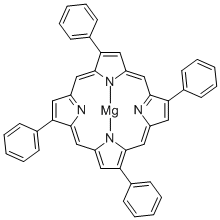
Magnesium meso-tetraphenylporphine is a metalloporphyrin compound with the chemical formula [Mg(C₄₄H₂₈N₄)], formed by the complexation of a tetraphenylporphyrin ligand with a magnesium ion, commonly found as a monohydrate. Structurally analogous to natural chlorophyll, the magnesium ion sits at the center of the porphyrin ring, coordinated to four pyrrolic nitrogen atoms to form a stable planar structure, and can further axially coordinate with other molecules to adopt penta- or hexa-coordinate forms. As an important biochemical reagent and organic compound, its stable structure and tunable photophysical properties make it a versatile platform molecule bridging fundamental research and industrial applications, holding significant value in multiple cutting-edge fields including photocatalysis, sensing, biomedicine, and materials science.
Product Categories: metal porphine (porphyrin) complex
Characteristics
Appearance & Form: Purple crystal
Solubility: DMSO (Very Slightly), Methanol (Slightly)
Stability: Light Sensitive
Applications
This product finds specific applications in the following fields:
1.Photocatalysis & Organic Synthesis:
Oxidation Catalysis: Acts as an efficient catalyst to promote organic transformation reactions such as hydroxylation of alkanes and epoxidation of alkenes, mimicking enzymatic catalysis to improve reaction selectivity and efficiency.
Photosensitization: Can form adducts with oxygen in photochemical reactions, applicable in photosensitized redox processes with potential in environmental pollutant degradation and photocatalytic hydrogen production.
2.Sensing & Gas Storage:
Chemical Sensing: Functions as a chemical sensor for detecting gas molecules like oxygen and nitrogen oxides, based on changes in its coordination state.
Gas Adsorption: Its porous coordination polymers formed with bridging ligands possess high surface area, suitable for the adsorption and storage of gases such as hydrogen or carbon dioxide.
3.Medical & Biological Fields:
Antibacterial Activity: Exhibits significant antibacterial activity against various Gram-positive and Gram-negative bacteria, useful for developing novel antibacterial agents.
Photodynamic Therapy: Its derivatives can serve as photosensitizers, generating reactive oxygen species under light to kill cancer cells, applicable in photodynamic therapy for cancer treatment.
Photosynthesis Mimicry: Used to study energy transfer and electron transport mechanisms, aiding the development of artificial photosynthetic systems for solar energy conversion.
Antifungal & Antioxidant: Its derivatives also demonstrate antifungal and antioxidant properties.
4.Materials Science & Optoelectronics:
Photoelectric Materials: Its excellent fluorescence and photophysical properties make it suitable for organic light-emitting diodes and solar cell materials. Performance can be enhanced by structural modifications.
Functional Materials: Its coordination polymer forms can be used to construct functional materials like crystalline structures, and it can also serve as a standard in spectroscopic analysis.
| File Name | Download |
|---|---|
| 14640-21-2 MAGNESIUM MESO-TETRAPHENYLPORPHINE COA .pdf |